
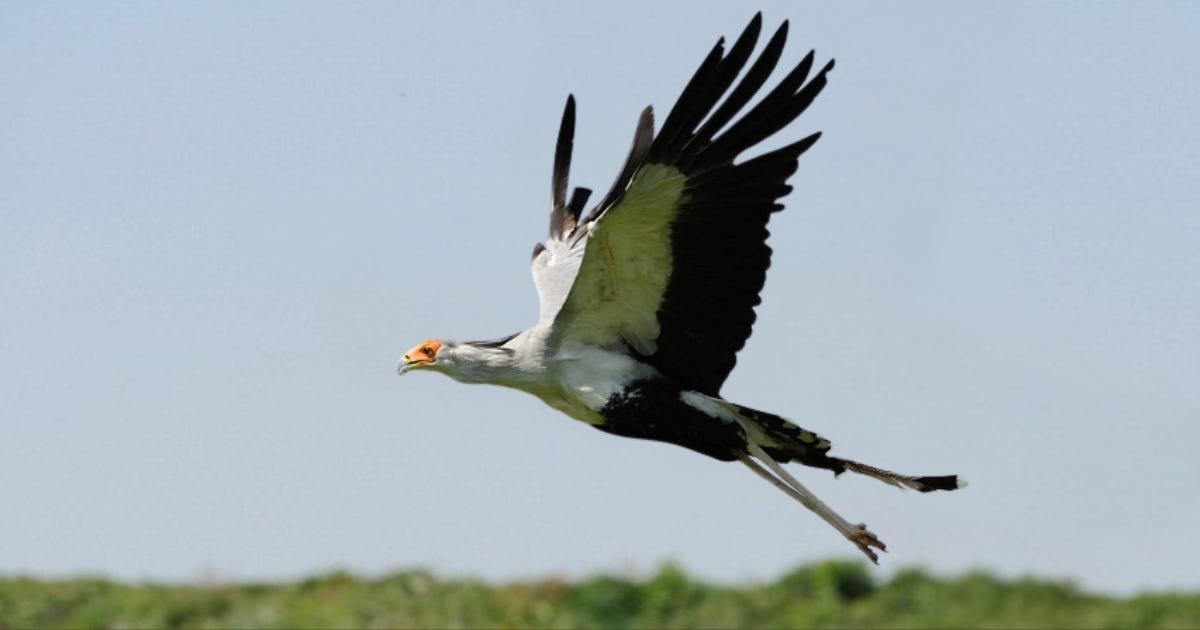
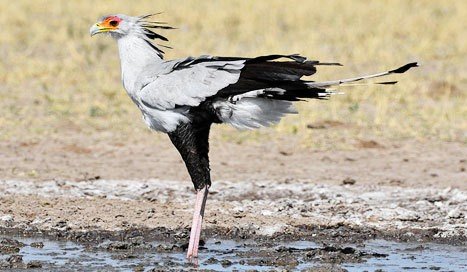
With an impressive wingspan of over 6.5 feet, a body length of 1.25 to 1.5 meters from beak to tail, and standing nearly four feet (3.9 feet) tall on long, pinkish lower legs, the Secretary Bird (Sagittarius serpentarius) is a truly unique raptor and the only member of the family Sagittariidae.
Unlike other raptors such as eagles, owls, and hawks, they spend much of their time moving on foot. This doesn’t mean they can’t fly. They take to the air only when needed, such as when reaching their nests in trees or performing courtship displays. And when they do, it’s often in a unique way.
In order to take off, the Secretary bird has to run a few steps with its wings spread to build momentum. Once in the air, it uses columns of naturally rising warm air currents (thermals) to gain altitude and soar with minimal or no energy expenditure (e.g., without flapping wings or using engine power) which allows them to reach impressive heights of up to 3,000 m, much like Pelicans and Cranes, making them an excellent glider. In flight, the two black bands across its tail are easy to see, and the two central tail feathers stretch well beyond its legs.
Why The Name, Secretary Bird?
Its name has been the subject of considerable debate in the past.
In 1769, Dutch naturalist, collector, and curator Arnout Vosmaer was sent a specimen by an official of the Dutch East India Company for examination. In his earliest publication, he wrote that the descendants of Dutch-speaking settlers on the eastern Cape frontier in South Africa popularly referred to as the “Boers” called it the secretarius. He believed this was a corrupted form of the better-known Sagittarius, as stated on the tag attached to the specimen when it was sent to him, since its manner of walking resembled that of an archer.
Why did locals choose to call it “secretarius”? Vosmaer noted that farmers in the area used the name, having domesticated the bird to help control pests around their homes. In that sense, the bird acted like a secretary.
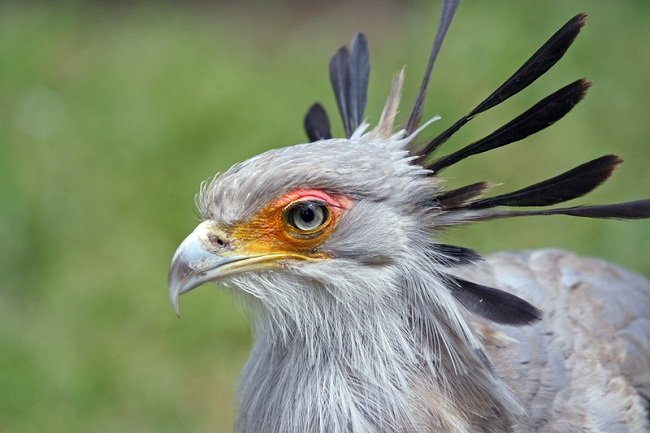
While Arnout Vosmaer believed secretarius to be a corrupted variation of Sagittarius. French naturalist, mathematician, and Enlightenment thinker Georges-Louis Leclerc, Comte de Buffon, believed otherwise. In 1780, he came up with a more believable explanation of the name. He described the bird as “Le Secrétaire ou Le Messager” (The Secretary or The Messenger). He was the first to propose the now widely accepted theory for the bird’s common name: that the long, black crest feathers on the back of its head resembled the quill pens that 18th-century clerks and secretaries used to tuck behind their ears.
Buffon’s account was highly influential and widely cited by later naturalists. In time, many began noting the resemblance of the 18th-century clerks and secretaries to the bird. During that period, male secretaries dressed in gray tailcoats and dark, knee-length trousers, often tucking goose-quill pens behind their ears. The Secretary bird mirrors many of these traits: the long, dark head quills resemble the pens, its long gray wing and tail feathers evoke a tailcoat, and the black feathers halfway down its legs look like short trousers.
Habitat
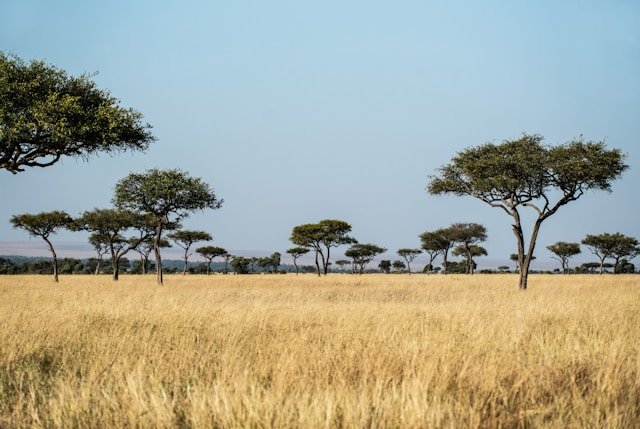
Secretary birds are natives to over 30 African countries. They prefer open places, like the savannas and grasslands, where the grass is below 100 cm in height, for an easy spotting of their preys or foods.
They are also often drawn to human-modified areas like fallow fields, grazing paddocks, airfields, and pastures that offers good food opportunities. They never go to places that will make feeding difficult for them, such as extremely arid deserts and heavily forested areas.
Behavior
The secretary bird is an excellent walker and can cover up to 30 km a day in search of food. Unlike its cousins, such as eagles and hawks, it is terrestrial, spending most of its day on foot. This is because it finds most of its food on the ground. It prefers to hunt independently, whether alone or among others.
To feed, it moves slowly and deliberately across its territory, watching the ground for potential prey. While insects make up about 86% of its diet, it also hunts small mammals, birds, amphibians, reptiles, and even venomous snakes like puff adders and cobras. Although it usually captures prey with its beak, this method does not work for all prey, especially snakes. To subdue snakes, it delivers quick, forceful strikes with powerful, repeated stomps of its feet behind the snake’s head to stun or kill it before eating. But that is not the only purpose its stomping serves.
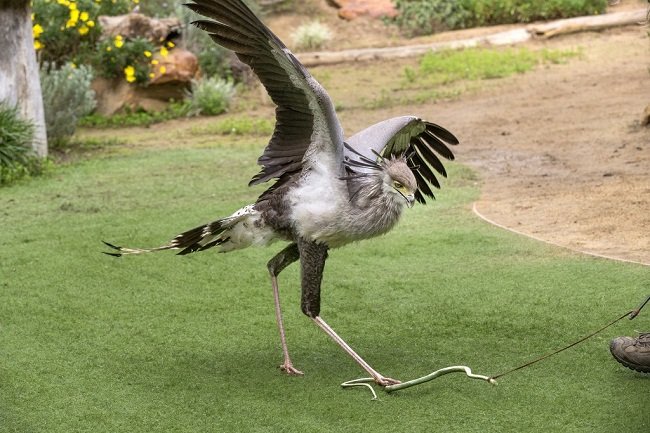
It also stomps on grassy mounds to drive out any hidden prey like lizards, grasshoppers, and small mammals. Once something moves, it increases its pace to catch it off guard. If the prey runs, it pursues it, using its wings for balance, until it catches it.
For digestion, the digestible soft tissues are broken down in the stomach and pass into the intestines. The indigestible, often sharp or hard, materials like bones, fur, teeth and shells remain in a muscular part of its stomach called the gizzard. In the gizzard, these leftover materials are compressed into a tight, oval-shaped ball called a “pellet.” The bird then “coughs up” or regurgitates this pellet, a process that typically happens at regular intervals, often once or twice a day.
In terms of sound, Secretary birds are generally silent. When they do call, it’s mostly at their nests, during courtship, or at roosts. The most common call is the “korrr-orr korrr-orr” sound.
When it’s time to rest, it flies up to its nest before nightfall or roosts under the canopy of a tree, often leaving its resting place only a couple of hours after sunrise.
Reproduction and Family Life
Secretary birds are monogamous and are widely believed to mate for life, forming strong pair bonds where they hunt, defend territory, and raise young together year after year, often maintaining the same nest. They can reproduce throughout the year; however, breeding generally peaks from late winter to early summer (August to March) or late in the dry season, often timed so that chicks fledge when food is most plentiful after the rains.
Courtship is mostly done in the air. They rise together above the nest site, croaking as they rise hundreds of meters high on thermals before carrying out rolling, wave-like displays. At times, one bird will swoop toward the other with its feet extended, and the other may turn to meet it with its claws.
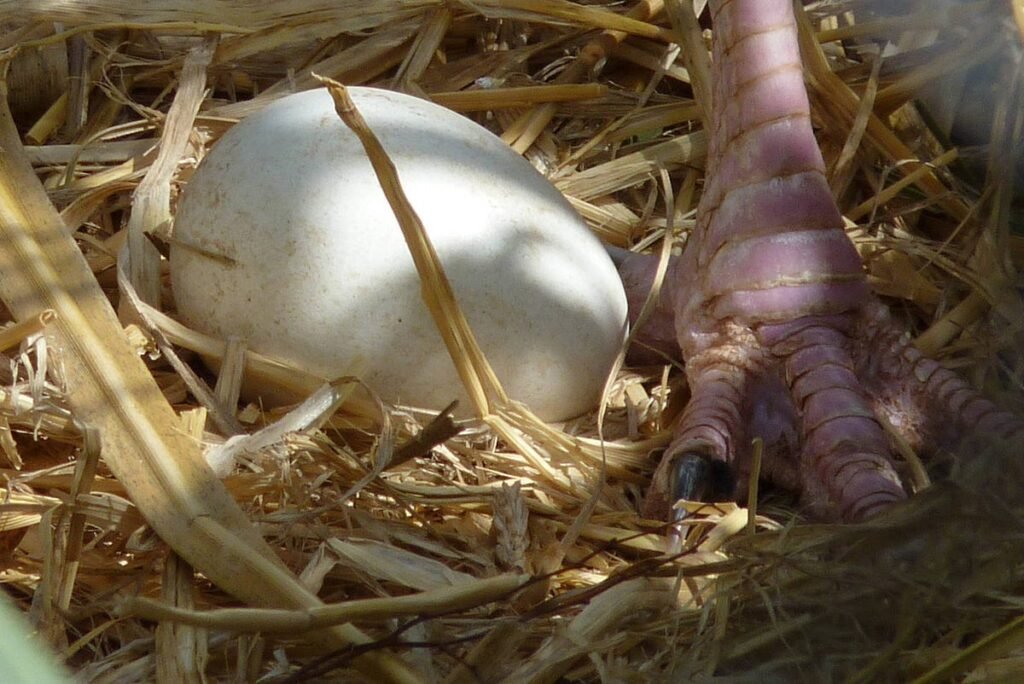
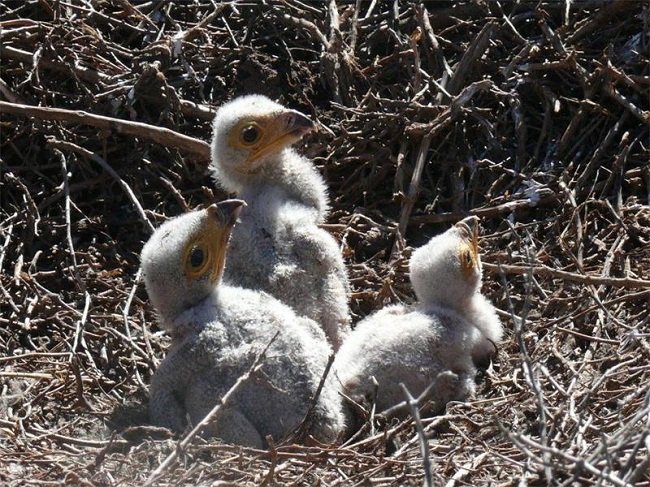
Their rough-textured white eggs do take about 50 days to hatch, and are hatched in the same order they were laid, with several days between each chick. The chicks are fed mainly from regurgitated food to small mammals by both parents as they grow older, attempting their first flight by the third month, after which they are taught to hunt and fly for several more weeks. Both parents work together to build the nest, which measures 100 to 250 cm wide and 28 to 50 cm deep, using grass, wool, twigs, animal dung, and leaves, usually in an acacia tree.
Life Expectancy, Threats and Conservation
A secretary bird lives about 10 to 15 years in the wild, but can live significantly longer in captivity, reaching up to 19 or even 20 years.
While adult secretary birds generally face few threats from other animals due to their size and formidable stomping ability (even killing venomous snakes), their eggs and chicks are vulnerable to other predators like crows, ravens, and owls, with habitat loss and development being their biggest threats. They appear to be declining rapidly from their natural habitats due to human activities such as agricultural expansion, overgrazing, hunting, droughts, and land conversion.
Since 1968, the species has held Class A protection under the African Convention on the Conservation of Nature and Natural Resources. It is also listed in CITES Appendix II, which places controls on its trade.
Despite these efforts, the bird, which held Least Concern (LC) status on the IUCN Red List from 1988 to 2009, meaning it was at lower risk of extinction, dropped to Vulnerable (VU) status between 2011 and 2016. By 2020, the latest assessment at the time of writing, its status had further declined to Endangered (EN).
Its long-term survival depends on safeguarding the wide savanna areas it inhabits.