
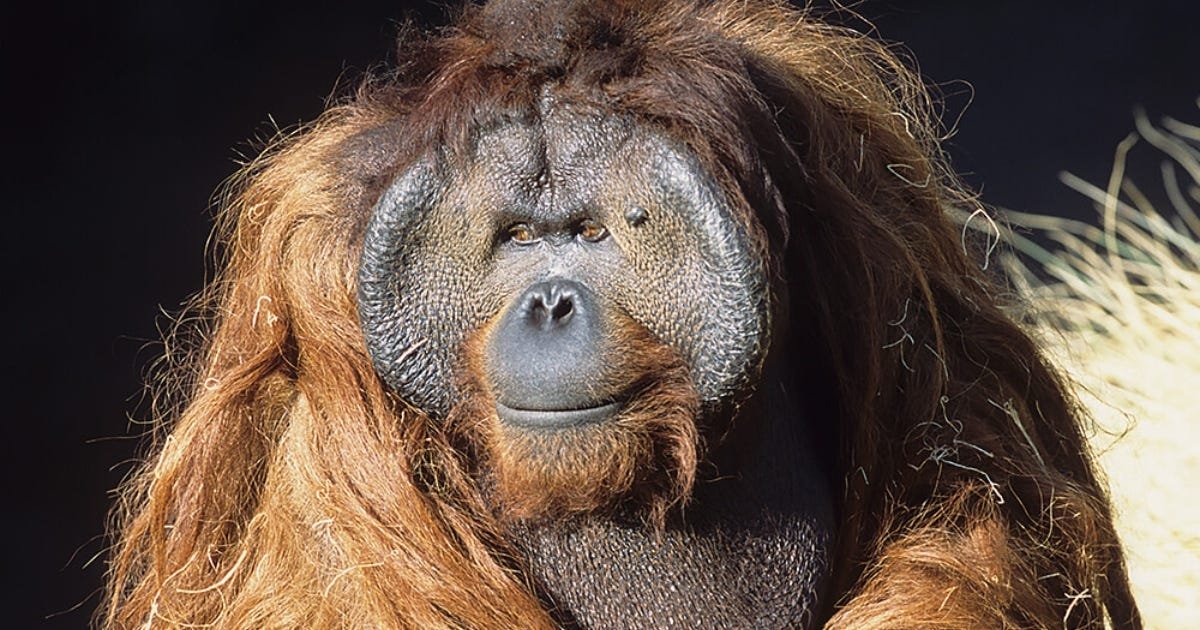
Ken Allen was a Bornean orangutan born at the San Diego Zoo in California on February 13, 1971, to Bornean orangutans Maggie and Bob. He became the zoo’s most famous resident because of a series of escapes in the 1980s that revealed both his intelligence and his persistence. He was named after zookeeper Ken Willingham and security officer Ben Allen, who rescued him as an infant due to his mother’s aggressive behavior toward him.
In 1985, Ken Allen gained global attention for escaping three times from an exhibit that had been considered secure. However, this behavior did not begin then. As the saying goes, “practice makes perfect,” and Ken had been honing his escape skills since infancy.
While in the zoo nursery, he showed his desire to be a “smooth criminal” by removing the bolts of his crib and unscrewing any light bulb he managed to get his hands on. By the time he was an adult, he had perfected his skills.
A 250-pound Ken carried out his first escape on June 13, climbing over the enclosure wall. His escapes did not involve aggression toward visitors. Contemporary reporting and later summaries indicate that during his breakouts, he often walked calmly among the exhibits, observing animals as if he were a guest, before zookeepers returned him to his enclosure. He appeared to enjoy the experience and was eager to repeat it — and repeat it he did.
Ken Allen escaped again on July 29 of that summer. During this breakout, he made his way to the enclosure of another orangutan named Otis, whom he disliked. He was seen throwing rocks at Otis before zookeepers led him back. This occurred after zookeepers, who wondered how he had escaped the first time, made his enclosure more secure and increased the height of the already massive wall by 4 feet.
His third documented escape in August 13 involved a crowbar that had been accidentally left in his pen. Ken, who understood he was being watched, passed the tool to another female orangutan, Vicki, who used it to open a window that let him out right after the zoo staff had left. Afterwards, the zoo temporarily moved him to an indoor pen while improving the enclosure’s security.
Desperate, the zoo staff made more changes. They made the surfaces more smoother and installed electrified wires along the perimeter. They also went undercover, watching the enclosure to try to catch him in the act, only to find Ken seemed to know when he was being observed. The staff thought that perhaps the reason he always left his pen was jealousy of Otis, who had more females than he did, since Ken was frequently seen harassing him. As a result, they gave him four more females, bringing his total to five, hoping it might distract him. Instead, he recruited them into his act.
Several months later, Jane (25) and Kumang (9) used a five-foot-long squeegee accidentally left behind by someone to scale the wall and escape. Jane was found walking near the flamingo exhibit and was tranquilized because she was a bit aggressive and refused to return to her pen, while Kumang was safely returned.
His ability to outwit confinement and his placid behavior made him a local celebrity. The zoo sold merchandise featuring his likeness, and he developed a fan following. Dennis Gersten wrote a song titled “The Ballad of Ken Allen” about him (a sample lyric reads, “smarter than a hundred humans at the San Diego Zoo”). Ken also had a fan club called the “Orang Gang” and was dubbed “The Hairy Houdini.”
Keeping Ken contained proved to be a significant challenge. Staff invested considerable time and money, spending over $40,000 to modify his exhibit and make it more secure. His impact extended beyond his own escapes: some of the other orangutans in his enclosure learned from his behavior and made their own escape attempts, leading to at least nine breakouts.
Despite repeated modifications to keep him inside, Ken continued exploring opportunities to escape. In one later incident, he attempted his fourth escape using an unconventional approach. This time, the zookeepers clearly caught him in the act but did not intervene. His adventure was ultimately brought to a halt after he touched the newly installed electric wires, and he eventually gave up trying.
Ken Allen lived at the San Diego Zoo for the rest of his life after the major escape period. He died on December 1, 2000, at age 29, after being diagnosed with B-cell lymphoma.